
Net Zero at Home: Aussie Households Achieving Energy Independence and Escaping the Cost of Living Crisis
Net Zero at Home: Aussie Households Achieving Energy Independence and Escaping the Cost of Living Crisis
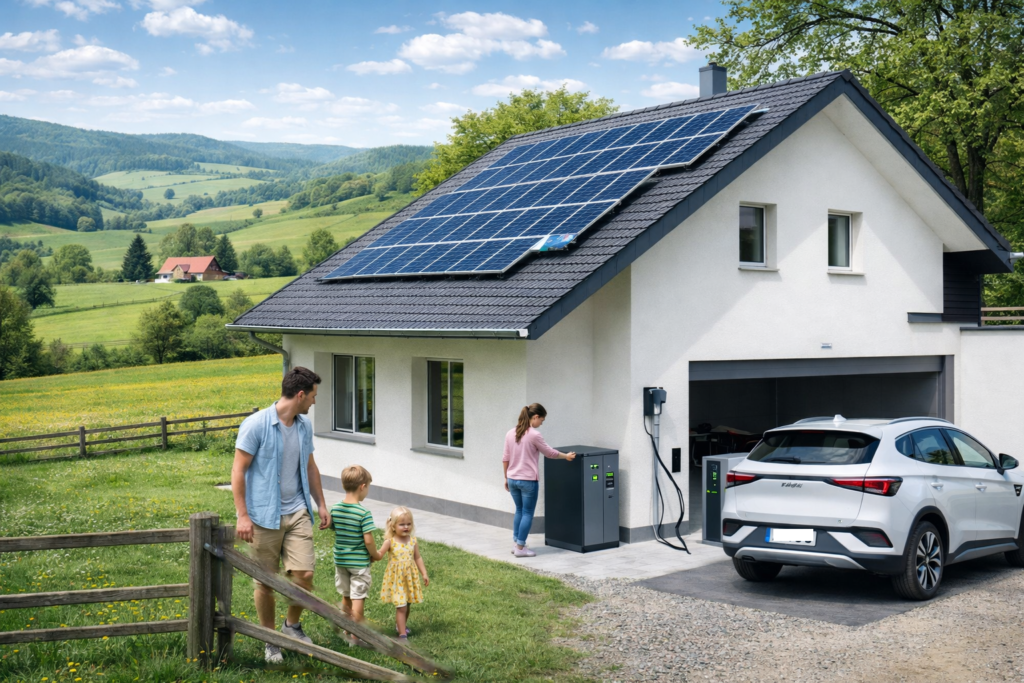
Aussie Households insulated from the Oil Price Shock. Here’s how.
While fuel hit $2.38 a litre and the cost-of-living crisis deepened, a quiet army of outer-suburban Australian families had already opted out. Not through ideology. Through maths.
On a weekday morning in Werribee, on Melbourne’s western fringe, Ingrid loads her two children into a BYD Atto 3 and drives them to school. The car charged overnight from a Fox ESS battery that spent the afternoon storing energy from the 13-kilowatt solar array on the roof. Her electricity bill last quarter was $11. Her petrol bill was zero. The Iran war sent fuel to $2.38 a litre last month, and she found out from a news notification, not a bowser shock.
Her household is part of a quiet revolution that has been building in Australia’s mortgage belt for the better part of a decade – and which the current energy crisis has suddenly made impossible to ignore. Across the outer suburbs of Melbourne, Sydney, Brisbane and beyond, a cohort of young, educated, financially pragmatic families have assembled what amounts to a personal energy system. Solar panels. A home battery. An electric vehicle. The combination delivers something that politicians have been arguing about for years: genuine household net zero. And it now costs less than a second-hand car to set up.
The geography of the revolution
The popular image of the clean energy household – inner-city, progressive, kombucha-adjacent – is factually wrong. The data tells a different story entirely. Australia’s highest solar penetration postcodes are not in leafy Mosman or Fitzroy North. They are in the mortgage belt: Tarneit, Craigieburn, Kellyville, Marsden Park, Hervey Bay, Bundaberg.
What these postcodes share is not a political colour. Tarneit swung to Labor in 2022 but had voted Liberal before that. Craigieburn is a bellwether seat fought bitterly by both major parties. Kellyville sits inside a safe Liberal electorate. What they share is a different set of variables: large separate houses with north-facing roofs, long commutes that make fuel costs acutely painful, young mortgages that create strong incentives to reduce ongoing costs, and a household demographic – educated 30-somethings with children – that is willing and able to evaluate a 10-year financial decision.
About to make an offer? Get an independent PropCred Pre-Purchase Analyst Report with price guidance, rental returns and a clear buy or don’t buy recommendation. Delivered within one hour.
The trifecta – and what it actually costs
The household energy trifecta has three components that work together as a system. Solar panels generate electricity during the day. A home battery store the surplus for evening use. An electric vehicle replaces the petrol car and charges from the solar-battery system, often for free. Each component has dropped dramatically in price over the past decade. Together, they now represent a financially rational choice for a broad middle-income Australian household.
| Component | Typical spec | Installed cost (2026) | Key product | Payback |
|---|---|---|---|---|
| Rooftop solar | 10–13 kW | $6,000–$9,000 | Various (Q-Cells, Jinko, REC) | 3–5 years |
| Home battery | 41.93 kWh (Fox ESS L9) | $5,500–$6,000 | Fox ESS KH10 + EQ4800 | ~2 years |
| Electric vehicle | 300–430 km range | $24,000–$36,000 | BYD Atto 1 / Dolphin / MG4 | 3–4 years |
| Total system | ~$35,000–$50,000 | 3–5 years (combined) |
The battery number deserves particular attention. The Fox ESS KH10 paired with the company’s EQ4800 modular lithium iron phosphate (LFP) battery stack – configured at its maximum 9-module, 41.93 kWh capacity – was being installed across metropolitan Victoria, New South Wales and Queensland in early 2026 for $5,500–$6,000 all-in, after the federal government’s Cheaper Home Batteries rebate. That is a system capable of storing two full days of average household electricity. It is AC coupled – meaning it bolts onto an existing solar installation without replacing it – and includes blackout protection, so when the grid goes down, the household keeps running.
The average Australian household uses 15–20 kWh per day. A Fox ESS 41.93 kWh battery is approximately two full days of household electricity. Paired with a 10–13 kW solar system that generates 40–55 kWh on a good day, the household can run indefinitely off-grid in normal weather conditions – with enough surplus to fully charge an EV overnight.
The savings that made petrol irrelevant
The financial case is unambiguous. A conventional Australian household with two petrol cars, a gas hot water system and no solar is currently paying approximately $9,300 per year in energy and fuel costs – and that figure was calculated before the Iran war shock pushed petrol above $2.38 per litre. The trifecta household, by contrast, has largely eliminated each of those line items.
The petrol calculation is particularly stark in 2026. A household with two cars, each driving 15,000 kilometres a year in vehicles averaging 8 litres per 100 kilometres, was spending approximately $5,700 annually on petrol at $2.38 per litre – up from roughly $4,200 eighteen months ago. That single line item alone now covers the entire cost of a Fox ESS battery installation within fourteen months.
If you’re buying a home, making that decision without an independent, objective view is a risk many buyers underestimate. Before you make an offer, order a PropCred Pre-Purchase Analyst Report (for only $39) to get an independent analysis of the property you are buying.
Our analysts with extensive industry experience provide professional insight specific to your property purchase. The professional property analysis deck prepared by our analyst team includes price guidance, rental returns, growth potential, and clear buy–or–don’t-buy recommendations, with the reasoning laid out behind the numbers. Reports are typically delivered within one hour.
The Chinese manufacturers who made it possible
No analysis of this revolution is complete without acknowledging its industrial origin: China. The same manufacturing scale and cost trajectory that drove solar panel prices down 75% between 2010 and 2025 has now arrived in batteries and electric vehicles simultaneously. The parallel is precise enough to be striking.
| Category | Early peak price | Current price (2026) | Price drop | Driver |
|---|---|---|---|---|
| Solar panels (6.6 kW system) | $15,000–$20,000 | $3,500–$5,500 | ~75% | Chinese mfg scale |
| Home battery (10+ kWh) | $12,000–$18,000 | $5,500–$8,000 | ~55% | Fox ESS, BYD, Sungrow |
| Entry EV (new) | $55,000–$75,000 | $24,000–$36,000 | ~55–65% | BYD, MG, GWM, Chery |
Fox ESS – the Chinese inverter and battery manufacturer that ranked number one for residential energy storage sales across Europe in the first half of 2025 – has quietly become the dominant battery brand in Australian suburban installations. Its 10kW KH10 hybrid inverter, paired with the modular EQ4800 LFP battery stack, is the system that most installers are now quoting. Its Australian operation runs from Melbourne, with 40 sales staff and 25 technical support personnel. It signed Olympic champion Ian Thorpe as its brand ambassador. It is, in every practical sense, an Australian household name that most journalists haven’t noticed yet.
On the EV side, the price collapse has been equally dramatic. BYD’s Atto 1 – a compact SUV with 310 kilometres of range – launched in Australia at $27,990 plus on-road costs, undercutting the Toyota Yaris and Suzuki Swift on sticker price. The MG4 Urban is $31,990 drive-away. The GWM Ora comes with a seven-year unlimited kilometre warranty and vehicle-to-load capability that can power household appliances from the car’s battery. These are not compromises. They are competitive products at prices that have removed the last significant barrier to EV adoption for the outer-suburban family.
| Model | Price | Range | Battery | Warranty | V2L |
|---|---|---|---|---|---|
| BYD Atto 1 Essential | $23,990 +ORC | 220 km | 30 kWh | 6yr / 8yr batt | – |
| BYD Atto 1 Premium | $27,990 +ORC | 310 km | 43.2 kWh | 6yr / 8yr batt | – |
| BYD Dolphin | $29,990 +ORC | 340 km | 44 kWh | 6yr / 8yr batt | – |
| MG4 Urban | $31,990 drive-away | 415 km | 51 kWh | 7yr unlimited | – |
| GWM Ora Lux | $33,990 drive-away | 400 km | 57.7 kWh | 7yr unlimited | 6 kW |
| Chery E5 | $36,990 | 430 km | 61.1 kWh | 7yr unlimited | – |
The solar arc Australia forgot it was living through
There is a useful historical parallel here that gets underappreciated. In 2008, a rooftop solar system cost $15,000–$20,000 and was the exclusive province of the environmentally committed wealthy. By 2015, the same system cost $6,000 and was appearing on the roofs of working-class households in western Sydney and outer Brisbane. By 2020, it had reached 1 in 4 Australian homes. Today it is on 1 in 3 – and the national average system size has grown from 3 kilowatts in 2012 to 10.81 kilowatts in November 2025, as households stopped thinking of solar as a partial bill reducer and started thinking of it as an energy independence platform.
Batteries and EVs are now running the same curve, seven to ten years behind. The households in Tarneit and Craigieburn who installed solar in 2017 and are now adding batteries and EVs are not early adopters. They are the early majority. And as Minister Bowen’s Blacktown-versus-Bondi comparison illustrates, they have been ahead of the cultural narrative for years.
The limits: who is still locked out
It would be dishonest to write about this revolution without noting its boundaries. The trifecta household requires three things that not every Australian has: a separate house with a north-facing roof, the capital or borrowing capacity to invest $35,000–$50,000 across three purchases, and an income sufficient to absorb the upfront cost in exchange for long-term savings. This excludes approximately 30% of Australians who rent, most apartment and unit dwellers, and households in genuine financial stress who cannot access the upfront capital regardless of the payback timeline.
The Iran war fuel shock is therefore having an asymmetric effect. The mortgage-belt family in Tarneit with solar, a Fox ESS battery and a BYD barely felt it. The renting family in Footscray with two ageing petrol cars felt it immediately and painfully. The energy transition is working – but it is working unevenly, and the gap between the insulated and the exposed is widening.
Most buyers rely on agents, emotion or market noise. PropCred gives you something different.
For just $39, our analyst team prepares a professional pre-purchase investment deck tailored to your property. We break down fair value, rental potential, long-term growth drivers and risk factors, with a clear recommendation and the reasoning behind it.
Independent. Data-driven. Delivered within one hour. Before you commit hundreds of thousands, get the numbers right.
What happens next
The federal battery rebate that triggered the 2025 installation surge is being wound back from May 2026. The window that allowed a household to install 41.93 kWh of storage for $5,500 is narrowing. But the underlying economics are structural, not temporary. LFP battery prices continue to fall. Chinese EV manufacturers continue to add models and cut prices. The New Vehicle Efficiency Standard is pushing all manufacturers to bring more electrified options to the Australian market faster. The BYD Atto 1 at $23,990 will not be the cheapest EV in Australia for long.
There is also the emerging vehicle-to-home (V2H) dimension. Several of the affordable Chinese EVs now on sale in Australia support vehicle-to-load functionality – meaning the car’s 40–60 kWh battery can power household loads directly. A household with solar, a home battery, and a V2L-capable EV has effectively three layers of energy storage and backup. During a grid outage, they can run for days. In a severe weather event or a sustained energy crisis, their resilience is categorically different from a conventional household’s.
The families in Tarneit and Craigieburn and Kellyville did not set out to solve the energy crisis, decarbonise the grid, or make a political statement. They set out to reduce their bills and protect their household budgets. In doing so, collectively and without central coordination, they have built something remarkable: a distributed, resilient, privately funded energy infrastructure that is quietly making the geopolitics of oil increasingly irrelevant to their daily lives.
When the Strait of Hormuz closes and petrol hits $2.38 a litre, that is not nothing. For the rest of Australia, it is a crisis. For them, it is a news notification they read over a $0 electricity bill.

Leave a Reply