The Last River Estate: What 24 Mayfield Street Reveals About Scarcity, Constraint, and the True Price of Permanence in Inner Melbourne
An 1892 timber homestead on the Yarra River is asking $5.5 million to $6 million. The guide is defensible. So are the risks. Understanding which is which requires a different framework than the one most buyers bring.
The house is a two-storey double-fronted timber structure on a steep site overlooking the Yarra River. Access from Mayfield Street is via the rear of the upper level – meaning the main facade actually addresses the river, not the street. The ground floor has brick piers with rendered bases and ornamental moulds, infilled with weatherboard. The hipped corrugated iron roof features a face brick corbelled chimney.
Before you make an offer
If you’re buying a home, making that decision without an independent, objective view is a risk many buyers underestimate. Before you make an offer, order a PropCred Pre-Purchase Report (for only $39) to get an independent analysis of the property you are buying. Our analysts with extensive industry experience provide professional insight specific to your property purchase.
The professional report prepared by our analyst team includes price guidance, rental returns, growth potential, and clear buy-or-don’t-buy recommendations, with the reasoning laid out behind the numbers. Reports are typically delivered within one hour.Order your PropCred Pre-Purchase Report – $39 →
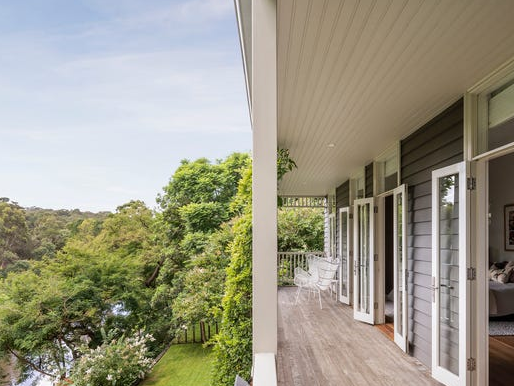
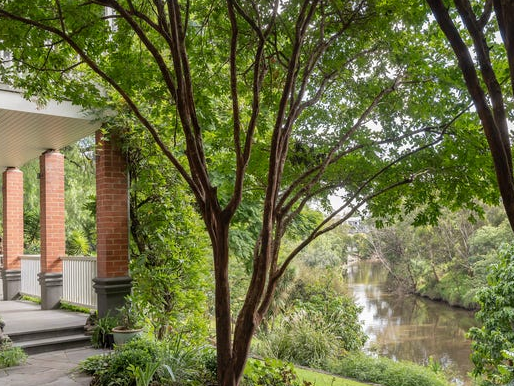
This orientation detail matters: most properties present their best face to the street. This one presents to the river and bushland. That is structurally unusual and reinforces the “estate, not a house” positioning.
The property was built in 1892 by John Buchan, a property developer who owned land adjacent to the Yarra. It is one of a pair of once-identical houses – the other being at 67 Church Street, Abbotsford. Both were completed in 1892 and sat on land formerly part of the historic Mayfield estate.
That history gives the property genuine provenance – which under heritage law carries specific weight.
The Heritage Situation
HO37 – Individual Heritage Overlay
The Yarra City Council’s Database of Heritage Significant Areas classifies 24 Mayfield Street under Heritage Overlay HO37, with a grading of “Individually Significant” – the highest category of local heritage classification, dated to 1892. Planning
“Individually significant” is not the same as being in a heritage precinct. It means the building itself has been assessed and found to have standalone significance. The implication:
Under a Heritage Overlay, a planning permit may be required for demolition, buildings and works. Even minor works – changing windows, doors, or installing services – can require a permit. Applications must include architect-prepared plans, a response to Council’s local heritage policy (Clause 15.03-1L-02), photographs of the property and surroundings, and potentially a Heritage Report from a qualified heritage expert and a structural report. Yarra City Council
In plain terms: you cannot renovate freely. Any alteration – including things that feel cosmetic – may require a formal permit, heritage assessment, and potentially months of Council review.
HO5 – Precinct-Level Heritage Overlay
This is a second, broader overlay covering the wider precinct. Being subject to two overlays simultaneously (individual + precinct) means the controls are compounded, not interchangeable.
Independent. Data-driven. Delivered within one hour.
For just $39, our analyst team prepares a professional pre-purchase property analysis tailored to your property. We break down fair value, rental potential, long-term growth drivers and risk factors, with a clear recommendation and the reasoning behind it.
Unlikely – would need heritage and planning assessment
3. The Flood Overlay – Quantified
The Land Subject to Inundation Overlay (LSIO) in the City of Yarra applies to land that is not in the primary floodway, but in flood storage or flood fringe areas affected by the 1-in-100-year flood event. It is applied by Melbourne Water and aims to ensure development does not interfere with the free passage of floodwaters or cause a significant rise in flood levels.
For a property sitting directly on the Yarra with a steep slope, the LSIO is confirmed and material. What buyers need to understand:
Insurance: Flood overlays trigger higher premiums and potential exclusion clauses. You must get insurance quotes before committing, not after. Some insurers will decline this property class entirely.
Renovation scope: Works that affect the footprint, floor levels, or drainage require Melbourne Water referral as a responsible authority – adding time and cost to any building permit.
Resale: Future buyers will face the same constraints, which structurally reduces your buyer pool at exit.
Estimated valuation drag from flood overlay: –5% to –12% versus an equivalent clean-title property.
4. Heritage + Flood Combined – The Overlay Stack
It is not uncommon for properties adjacent to the Yarra River to carry both a heritage overlay and a land subject to inundation overlay simultaneously. Together, these can make development of the land more restricted, require adherence to heritage guidelines, and require additional planning permits for works that would otherwise not need approval.
The compounding effect is real. A buyer who acquires this property should model two scenarios:
Minimal intervention: Accept the property largely as-is, undertake only works that are clearly permittable, and focus on maintenance over renovation.
Active improvement: Budget for heritage architects, permit cycles of 3–6+ months, and potential VCAT appeals if permits are contested. Add 20–35% to any renovation budget estimate versus a non-heritage property.
5. Comparable Sales
Standard Abbotsford sales are irrelevant. Melbourne’s prestige market operates differently from the broader residential market – trophy and scarcity assets are less affected by interest rate movements and more influenced by buyer sentiment and available supply.
The honest position is that true comparables for this property do not exist in volume. The relevant peer group is:
Large-land (>800 sqm) inner Melbourne houses with heritage classification
Properties with water or parkland adjacency as a permanent feature
EOI or private treaty sales in the $4.5M–$7M range across Yarra-adjacent suburbs (Richmond, Fitzroy, Collingwood, Kew near the river)
From available market data, a 4-bed heritage home on ~950 sqm in Essendon transacted at $5.95M in 2024 via EOI. 9 Salmon Avenue, Essendon – 4 bedrooms, 5 bathrooms, 5-car garage on 948 sqm – sold for $5.95M via Expression of Interest, attracting affluent buyers not wanting to go through the build process themselves.
That comparable is instructive: similar bedroom/land profile, premium price, similar buyer type. But 24 Mayfield adds river frontage and protected outlook – which in theory supports the upper end of the guide. The offset is Essendon has no flood overlay and likely lighter heritage constraints.
Adjusted view: The $5.5M–$6.0M guide is professionally calibrated. It is not cheap. It is not irrational. It reflects where the agent believes 2–3 motivated buyers will compete.
Who Buys This Property (And Who Shouldn’t)
The right buyer has all three of these characteristics:
Not yield-dependent. Gross rental yield on a $5.5M+ property in this location will likely be under 2% (assuming $80–$100K/year achievable rent across multiple dwellings). This is a wealth storage play, not a cash flow play.
Not renovation-dependent. If your plan requires a significant structural upgrade, extension, or modern rebuild, the heritage constraints will frustrate you. Budget for specialist advisors before assuming any works are feasible.
Values permanence over liquidity. This property may take 6–18 months to sell at the right price when you eventually exit. If you need capital flexibility in 3–5 years, this is a risk.
The wrong buyer is anyone who buys on the basis that they can “fix it up” or “unlock the land value.” The overlays foreclose that thesis.
About to make an offer?
Get an independent PropCred Pre-Purchase Report with price guidance, rental returns and a clear buy-or-don’t-buy recommendation.
Conclusion: The guide sits in the middle-to-lower end of the realistic range. You are not buying a bargain, but you are also not paying an irrational premium if you value the frontage and scarcity correctly.
Get a full planning report from Yarra City Council’s Planning Portal – confirm all overlays on the specific title (LSIO, HO37, HO5, any Special Building Overlay).
Call three insurers for flood quotes on a like-for-like property value – if premiums are >$15,000/year or exclusions are material, factor that into your holding cost model.
Engage a heritage architect for a 2-hour feasibility consult – you want to know, before bidding, what works are permittable and at what cost.
Commission a pre-purchase building inspection by a firm experienced in 1890s timber construction – rising damp, termite history, structural movement on a steep riverside site, and roof condition are the key risk areas.
Find out the vendor’s motivation – EOI with no reserve is not an auction. The vendor controls acceptance. Understanding whether they are testing the market vs. needing a sale in this campaign window changes your negotiation approach entirely.
9. Bottom Line
This property is fairly priced for what it is. It rewards a buyer who values scarcity, permanence, and lifestyle over yield, flexibility, or redevelopment upside. The flood and heritage overlays are not dealbreakers – but they are real constraints that must be priced into both your offer and your long-term holding model before you commit.
38 Westgrove Drive, Ellenbrook WA 6069 For sale · Private treaty
Price Discovery Band: $950,000–$1.05 million
Transparent campaign: the range above comes... read more


Leave a Reply