
Will the RBA deliver a fourth rate hike in 2026?
Will the RBA deliver a fourth rate hike in 2026?
The central bank lifted its benchmark rate to 4.35 percent, reversing all of the cuts it made last year, as policymakers warn that soaring fuel prices risk entrenching inflation. Markets are now pricing in at least one more increase before year’s end.
Australia’s central bank raised interest rates for the third consecutive meeting on Tuesday, pushing its cash rate to 4.35 percent as it sought to contain an inflation threat amplified by the economic fallout of the war in the Gulf.
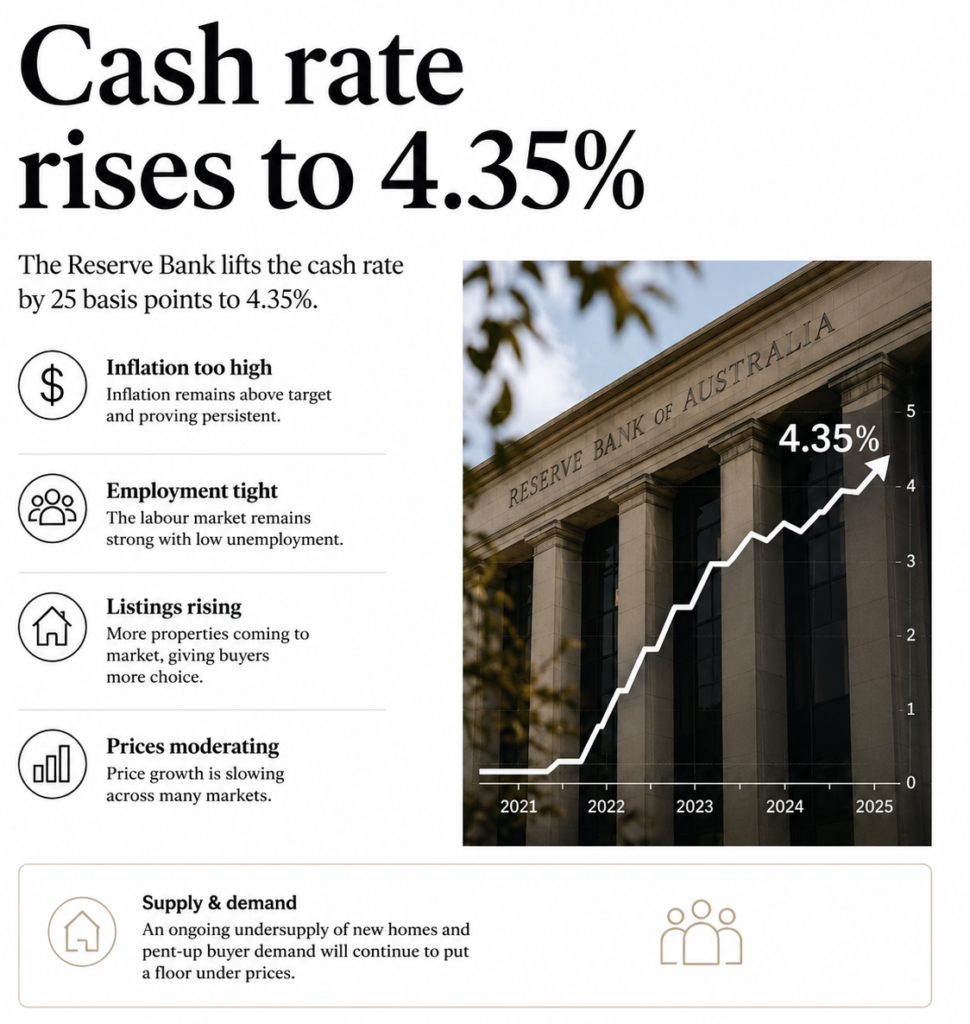
The decision by the Reserve Bank of Australia’s Monetary Policy Board, which was widely anticipated by financial markets and most economists, completes a full reversal of the three rate cuts the bank made between February and August of last year.
Eight of the board’s nine members voted in favour of the increase, concluding that higher fuel prices were “likely to have second-round effects on prices for goods and services more broadly” – a concern compounded by what the bank described as “high inflation recorded around the start of 2026, reflecting capacity pressures in the economy.”
If you’re buying a home, making that decision without an independent, objective view is a risk many buyers underestimate. Before you make an offer, get an independent analysis of the property you are buying. Our analysts with extensive industry experience provide professional insight specific to your property purchase.
The professional report prepared by our analyst team includes price guidance, rental returns, growth potential, and clear buy-or-don’t-buy recommendations, with the reasoning laid out behind the numbers. Reports are typically delivered within one hour. Check your property here
The bank now expects headline inflation to peak at 4.8 percent through the June quarter, up from an earlier projection of 4.2 percent, before retreating to 2.4 percent by mid-2027 – assuming the Gulf conflict ends in the near term. Underlying inflation, which strips out volatile items and is closely watched by policymakers, is forecast to reach 3.8 percent in the current quarter and remain stubbornly above the bank’s 2 to 3 percent target band through mid-2027.
The revised projections, published Tuesday in the bank’s quarterly Statement on Monetary Policy, also reflect a dimmer outlook for growth. The RBA now expects the economy to expand by just 1.4 percent in each of the next two fiscal years, down from forecasts of 1.8 percent and 1.6 percent respectively. Unemployment projections for late 2027 and early 2028 were nudged slightly higher, to 4.6 and 4.7 percent.
A Split Among Forecasters
The question now dividing economists is whether Tuesday’s move will be the last. Markets are pricing in at least one further increase this year, and Westpac’s chief economist, Luci Ellis, said she shares that expectation. But Commonwealth Bank’s head of Australian economics, Belinda Allen, struck a more cautious note, arguing the RBA is likely to hold rates steady from here as it assesses the impact of the tightening already delivered.
The disagreement reflects genuine uncertainty about whether Gulf-driven fuel price pressures will prove temporary or feed more durably into wages and broader consumer prices – the central judgment the board itself acknowledged remains finely balanced.
Not all economists were convinced the increase was necessary even now. Some argued the RBA could have paused to assess whether the surge in fuel prices – which already acts as a drag on household budgets in ways that mimic a rate rise – warranted an immediate policy response. The bank’s majority, however, judged that the risk of waiting outweighed the cost of acting.
About to make an offer?
Get an independent PropCred Pre-Purchase Report with price guidance, rental returns and a clear buy-or-don’t-buy recommendation.
A Warning to Canberra
Governor Michele Bullock used her post-meeting press conference to issue what amounted to a pointed warning to the federal government ahead of next week’s budget: fiscal relief for households, however well-intentioned, risks working at cross purposes with monetary policy.
“The extent to which the government makes up the shortfalls for households by giving them more money,” she said, “it makes it harder to dampen demand.”
The remark carried sharp timing. Press reports indicate the government is preparing another round of cost-of-living payments next week – measures that, in the bank’s view, could sustain the very spending pressures it is trying to cool. What Canberra gives, in other words, the RBA may feel compelled to take back.

Leave a Reply